


 Cart
Cart
 sales@molnova.com


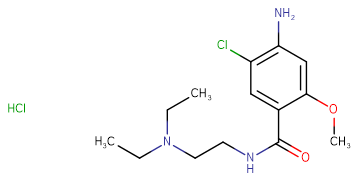
Metoclopramide hydrochloride
CAS No. 7232-21-5
Metoclopramide hydrochloride( NSC 354467 )
Catalog No. M15767 CAS No. 7232-21-5
Metoclopramide hydrochloride is a selective dopamine D2 receptor antagonist, used for the treatment of nausea and vomiting.
Purity : >98% (HPLC)
 COA
Datasheet
HNMR
HPLC
MSDS
Handing Instructions
COA
Datasheet
HNMR
HPLC
MSDS
Handing Instructions
| Size | Price / USD | Stock | Quantity |
| 25MG | 45 | In Stock |


|
| 50MG | 64 | In Stock |
|
| 100MG | 83 | In Stock |
|
| 200MG | 132 | In Stock |
|
| 500MG | Get Quote | In Stock |
|
| 1G | Get Quote | In Stock |
|
Biological Information
-
Product NameMetoclopramide hydrochloride
-
NoteResearch use only, not for human use.
-
Brief DescriptionMetoclopramide hydrochloride is a selective dopamine D2 receptor antagonist, used for the treatment of nausea and vomiting.
-
DescriptionMetoclopramide hydrochloride is a selective dopamine D2 receptor antagonist, used for the treatment of nausea and vomiting.(In Vitro):Metoclopramide (0.01-10 μM) hydrochloride hydrate stimulates aldosterone release in isolated perfused rat zona glomerulosa cells.Metoclopramide hydrochloride hydrate results in prokinesis by four mechanisms: inhibition of presynaptic D2 receptors and stimulation of presynaptic excitatory 5-HT4 receptors, thereby allowing acetylcholine (ACh) release from intrinsic cholinergic motor neurons; inhibition of D2 postsynaptic receptors; and antagonism of the presynaptic inhibition of muscarinic receptors, leading to further augmentation of ACh release.(In Vivo):Metoclopramide (6.7 μg/g; s.c. daily for 50 days) hydrochloride hydrate significantly increases the number and the volume of lactotroph cells of the pituitary gland during all phases of the estrous cycle.Metoclopramide (5-40 mg/kg; i.p.) hydrochloride hydrate induces catalepsy and antagonizes Apomorphine induced cage climbing behaviour in mice.Metoclopramide (1.25-2.5 mg/kg; i.p.) hydrochloride hydrate induces stereotyped cage climbing behaviour in mice.
-
In VitroMetoclopramide (0.01-10 μM) hydrochloride stimulates aldosterone release in isolated perfused rat zona glomerulosa cells.Metoclopramide hydrochloride results in prokinesis by four mechanisms: inhibition of presynaptic D2 receptors and stimulation of presynaptic excitatory 5-HT4 receptors, thereby allowing acetylcholine (ACh) release from intrinsic cholinergic motor neurons; inhibition of D2 postsynaptic receptors; and antagonism of the presynaptic inhibition of muscarinic receptors, leading to further augmentation of ACh release.
-
In VivoMetoclopramide (6.7 μg/g; s.c. daily for 50 days) hydrochloride significantly increases the number and the volume of lactotroph cells of the pituitary gland during all phases of the estrous cycle.Metoclopramide (5-40 mg/kg; i.p.) hydrochloride induces catalepsy and antagonizes Apomorphine induced cage climbing behaviour in mice.Metoclopramide (1.25-2.5 mg/kg; i.p.) hydrochloride induces stereotyped cage climbing behaviour in mice. Animal Model:Adult, virgin female mice of the Swiss EPM-1 strain Dosage:6.7 μg/g Administration:S.c. daily for 50 days Result:Increased the number but also stimulated the metabolic activity of lactotrophs.
-
SynonymsNSC 354467
-
PathwayEndocrinology/Hormones
-
Target5-HT Receptor
-
Recptor5-HT| mAChR| Dopamine
-
Research AreaOther Indications
-
Indication——
Chemical Information
-
CAS Number7232-21-5
-
Formula Weight336.26
-
Molecular FormulaC14H22ClN3O2·HCl
-
Purity>98% (HPLC)
-
SolubilityEthanol: 67 mg/mL (199.25 mM); Water: 67 mg/mL (199.25 mM); DMSO: 67 mg/mL warmed (199.25 mM)
-
SMILESCl.CCN(CC)CCNC(=O)C1=CC(Cl)=C(N)C=C1OC
-
Chemical Name——
Shipping & Storage Information
-
Storage(-20℃)
-
ShippingWith Ice Pack
-
Stability≥ 2 years
Reference
1.Burger DM, et al. J Vet Med A Physiol Pathol Clin Med. 2006 Mar;53(2):97-107.
molnova catalog



related products
-
RG2833
RG2833 (RGFP109), a brain-penetrant HDAC inhibitor, is with IC50 of 60 nM and 50 nM for HDAC1 and HDAC3, respectively.
-
KW-2478
KW-2478 is a non-ansamycin HSP90 inhibitor with IC50 of 3.8 nM.
-
Ataractan
Azacyclonol, also known as γ-pipradol, is a drug used to diminish hallucinations in psychotic individuals.
